For about a year I have been using the same line in calls, on this website and on LinkedIn: building got cheap, judgment didn’t. The fair question back is whether that is a feeling or something I can show.
So I went looking. I used a deep-research tool to pull together public data, then checked the key figures against the original sources: GitHub, Verisign, Apple, Google, Appfigures and a new paper on arXiv. Where a number only lived in a Reddit thread, I dropped it.
The short version: the first half of the line holds up very clearly. The second half shows up in the data too, just more quietly.
1. Code: the busiest year GitHub has seen
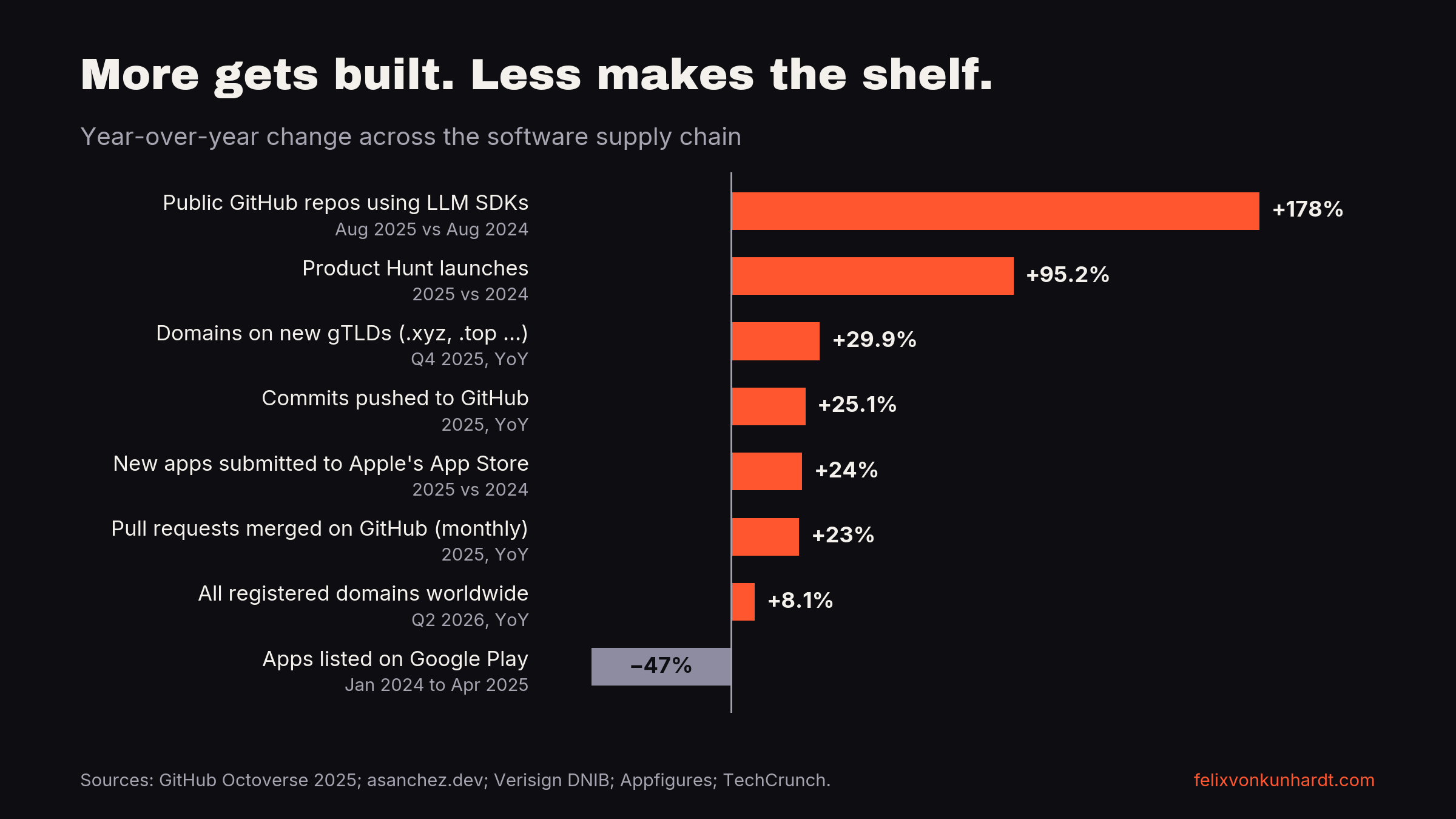
GitHub’s Octoverse 2025 report describes the fastest growth in the platform’s history.1 More than 36 million developers joined in one year, which takes GitHub past 180 million - roughly one new developer every second. Some 121 million new repositories were created, about 230 per minute. Developers pushed nearly a billion commits (+25% on the year) and merged 43.2 million pull requests per month (+23%).
Two details point directly at AI. 80% of new developers used Copilot in their first week on the platform. And the number of public repositories that import an LLM SDK grew by 178% in a year, to 1.1 million.1
I see the same thing at a very small scale. My brother and I are building a productivity platform with an AI agent co-authoring every commit, and on one Thursday in September the two of us merged thirty pull requests into the same repository. A few years ago that would have been a good week for a whole team.
2. Prototypes: from prompt to running app
Next to the classic developer tools, a new category has grown up: tools that turn a written prompt into a working web app, often called “vibe coding”. Vercel’s v0 alone reportedly saw 9.6 million projects created in 2025 and passed 4 million users by early 2026.2 Replit, one of the best-known tools in the category, reached an estimated $253 million in annual recurring revenue by October 2025, up from about $16 million at the end of 2024.3
Landing pages, prototypes and complete frontends now take minutes where they used to take weeks.
3. Domains: a new address for every idea
Every new product needs an address, so domain registrations are a useful signal. Verisign’s Domain Name Industry Brief counted 401.6 million registered domains at the end of Q2 2026, 29.9 million (8.1%) more than a year earlier.4 New .com and .net registrations per quarter rose from 10.1 million in Q1 2025 to 12.7 million in Q2 2026.4,5 Domains on the newer generic endings like .xyz or .top grew almost 30% year over year by the end of 20256 - those are the cheap endings people pick for quick experiments.
The clearest single curve is .ai. The ending belongs to Anguilla, a small Caribbean island, and has become the default address for AI products. In 2018 there were 48,272 .ai domains. Just before ChatGPT, in July 2022, there were 143,737. By December 2023 the count was 353,928, by October 2024 533,068, and in January 2026 it passed one million.7,8
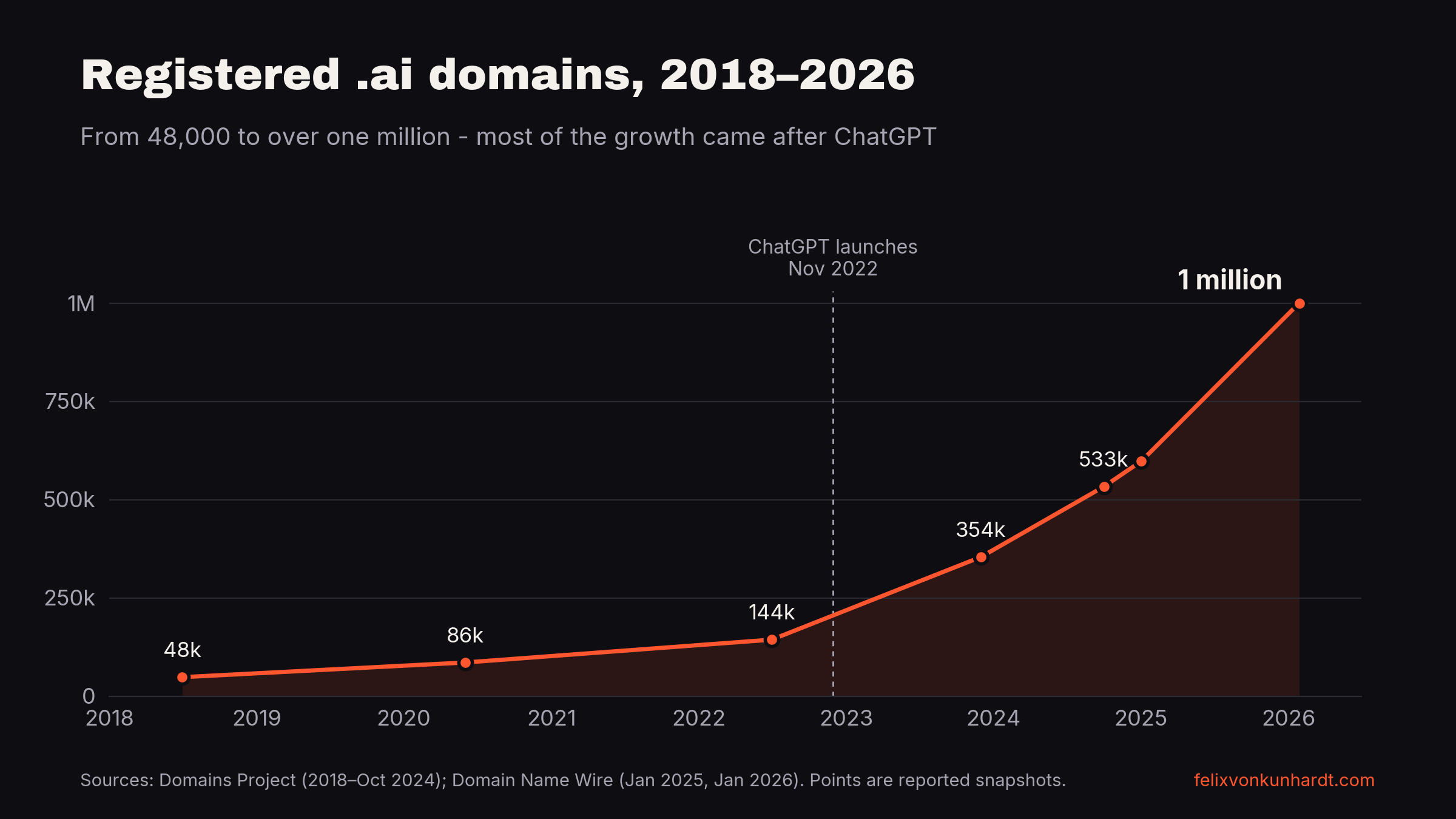
Some of that is speculation. An analysis cited by the Domains Project found that around 61% of .ai websites were parked domains or placeholder pages.7 The real products are in the curve as well: over 30% of recent Y Combinator AI startups use a .ai domain.7
4. Launches: twice as many products, most of them solo
Product Hunt is where many new software products announce themselves. An independent analysis of 263,088 launches between January 2020 and January 2026 found that launches in 2025 were up 95% on the previous year.9 The share of products that describe themselves through AI went from about 5% before ChatGPT to around 40% at the end of 2025. Around 69% of those used generic AI wording without anything more specific behind it.9
The more rigorous source is a paper by Hyunso Kim, Hyo Kang and Jaeyong Song, published on arXiv in May 2026.10 They studied more than 160,000 Product Hunt launches and found that the increase comes mainly from solo founders. Generative AI fills the gaps a missing team used to leave (frontend, code, copy), and solo launches grew even in categories that used to be team territory, like finance and sales software.
Their second finding is the one I find most interesting. Among solo ventures, the share of “one-shot” launches (no product update in the twelve months after launch) rose from 95.1% to 97% after ChatGPT. At the top of the rankings, teams still dominate.10
5. App stores: where the surge meets a filter
Mobile app stores are the part of the chain with a gatekeeper, and here the picture splits.
Apple received 557,000 new app submissions in 2025, up 24% from 448,000 in 2024, according to Appfigures.11 Apple itself reviewed 9.1 million submissions in 2025, new apps and updates together, and rejected more than 2 million of them.12
Google went further. The number of apps listed on Google Play fell from about 3.4 million at the start of 2024 to about 1.8 million in April 2025, a drop of 47%, after Google tightened its quality rules in mid-2024.13 In 2024 Google blocked 2.36 million policy-violating apps before publication and banned more than 158,000 developer accounts.14 New personal developer accounts must run a closed test with at least 12 testers for 14 days before an app can go public.15 For a team that is a small hurdle. For someone who generated an app over the weekend it is a real one.
What I take from this
More software is being built than ever, and the growth lines up with the tools that made building cheap. Code, prototypes, domains, launches, app submissions: every upstream number went up, and GitHub grew faster than at any point in its history.
Further down the chain the numbers look different. Almost all solo launches never get a second update. Most .ai addresses have no product behind them. The stores with a gatekeeper reject or remove more than ever. And the products at the top of the rankings still come from teams.
So the scarce part has moved. The effort now sits in deciding which problem is worth solving, what “good enough” means before anyone builds, when to stop, and how a team agrees on all of that. That is the part of product work I care about most, and the data suggests it matters more now, when anyone can have a working prototype by Friday.
Building got cheap. Judgment didn’t.
If your team ships more than ever: who decides what deserves a second release?
Sources
- GitHub, “Octoverse 2025: A new developer joins GitHub every second as AI leads TypeScript to #1,” 2025. github.blog - see also octoverse.github.com ↩
- SaaStr, “AI App of the Week: v0 by Vercel,” March 2026 (figures not confirmed by Vercel). saastr.com ↩
- Sacra, “Replit at $253M ARR growing 2,352% YoY” (analyst estimate). sacra.com ↩
- Verisign, “DNIB.com Reports Internet Has 401.6 Million Domain Name Registrations at the End of the Second Quarter of 2026.” investor.verisign.com ↩
- Verisign, “DNIB.com Reports Internet Has 368.4 Million Domain Name Registrations” (Q1 2025). investor.verisign.com ↩
- Domain Name Industry Brief, “The DNIB Quarterly Report Q4 2025.” dnib.com ↩
- Domains Project, “.ai Domains and the AI Gold Rush.” domainsproject.org ↩
- Domain Name Wire, “.AI namespace hits 1 million domain names,” 28 January 2026. domainnamewire.com ↩
- A. Sánchez, “AI’s Real Impact on Software Launches: Evidence from Product Hunt” (independent analysis). asanchez.dev ↩
- H. Kim, H. Kang, J. Song, “Generative AI Fuels Solo Entrepreneurship, but Teams Still Lead at the Top,” arXiv:2605.10291, May 2026. arxiv.org/abs/2605.10291 ↩
- Appfigures, “The App Store Just Logged Its Biggest Release Year,” December 2025. appfigures.com ↩
- Apple Newsroom, “The App Store stopped over $2.2 billion in fraudulent transactions in 2025,” May 2026. apple.com/newsroom ↩
- TechCrunch, “Google Play sees 47% decline in apps since start of last year,” 29 April 2025. techcrunch.com ↩
- Google, “How we kept the Google Play & Android app ecosystems safe in 2024.” blog.google ↩
- Google Play Console Help, “App testing requirements for new personal developer accounts.” support.google.com ↩