“Revenue doesn’t feel as safe as it used to.” An investor said this to me a few weeks ago, about software companies that have been solid businesses for years. Most of the companies he sees are still growing. But something has shifted in how secure that growth feels.
His explanation was simple. For a long time, nobody could realistically replace a system of record. The CRM, the ERP, the applicant tracking system: you built on top of them, never instead of them. Now young companies build so fast that they can turn the migration itself into a product. Instead of adding an app on top, they replace the whole system.
Building got cheap. Now switching is getting cheaper too.
1. The fortress is getting thinner walls
A system of record used to be the safest asset in software. All of a customer’s data lived there, every process was wired into it, and moving away meant a multi-year project with consultants, data cleanup and a lot of risk. Customers complained about their old systems, but they stayed.
These systems were protected by the cost of leaving, and a big part of that cost was technical: export the data, map it, rebuild the integrations, test everything. That part is exactly what AI is making cheaper.
2. What the market is saying
The markets reacted early and hard. In one week in early February 2026, the S&P 500 software and services index lost about $1 trillion in market value, partly triggered by new AI tools for knowledge work.1 The software index fell 27% between early January and the end of March, before recovering more than 30% by August.2 Private equity firms marked their software holdings down by 8.9% in a single quarter, while the wider market was rising, and new PE money going into software dropped by two thirds compared to the year before.2
The interesting part is that revenue didn’t collapse. Payment volumes of non-AI SaaS companies grew by 31.5% over twelve months, according to Stripe’s index.3 But growth is slowing: Bain reports that revenue growth in tech portfolios has roughly halved, from about 20% to about 10%, and net revenue retention has dropped by around eight points since 2021.4 And customers are signing shorter contracts. The share of software contracts running longer than 25 months fell from 64% to 29%, according to Battery Ventures.5
Revenue is still growing, but confidence in future revenue is increasingly under pressure.
3. Migration as a product
The clearest sign of the shift is that challengers now sell the move itself. In accounting, Campfire says that 20-30% of its customers are replacing NetSuite, with go-lives in four to eight weeks. Rillet talks about four to six weeks instead of four to six months, and DualEntry promises a migration in 24 hours.6 In recruiting, Gem offers to move customers off Greenhouse or Lever “overnight” for smaller teams, and Ashby promises data “in days rather than months”, plus a buyout of the old contract.7
These are vendor claims, and I read them that way. I have not found independent data on how much migration costs have really fallen. But the direction is clear, and so is the sales pitch: switching is no longer the scary part.
Not everyone goes this way. Plenty of new AI tools still sit on top of the old system and keep it as the system of record, simply because that is the easier sale.8 The window is real, but it’s not open everywhere.
4. Why not every incumbent falls
I don’t think this means every established software company is in danger. Moving off a core system still hurts, and mostly for reasons that have nothing to do with code.
The organizational switching costs are still brutal. Teams need retraining. Processes built around the old system have to be rethought. Reports that the CFO relies on suddenly look different. And there is what some call the implementer’s dilemma: the person who chose and introduced the current system has every career reason to defend it.
So the honest picture is this: technical switching got much cheaper, organizational switching didn’t. The window opens where a new product feels clearly better from day one, so clearly that it outweighs all of that pain. That makes it mainly a product question.
5. Switching from the inside: rebuilding your own platform
There is a second meaning of “switching” that I find even more interesting, and it came up in the same conversation. Many of the investor’s portfolio companies are startups and young scale-ups, and they are asking themselves whether to rebuild their own platform, now that AI makes it so much easier.
The public examples are mostly from large companies, and they show a clear pattern. Amazon used its AI assistant to upgrade thousands of Java applications and estimates it saved 4,500 developer-years and $260 million a year; an upgrade that used to take about 50 developer days now takes hours.9 Airbnb migrated about 3,500 test files to a new framework in six weeks, instead of the estimated one and a half years.10 Google reports that in one large migration, 80% of the code changes were AI-generated and the total time was cut roughly in half, though the model alone was “not sufficient” and only worked combined with classic tooling.11
The most instructive case is the insurer Unum, which is replacing its old COBOL core systems with AI support. Consultants had estimated seven years and $25 million for the switch. Unum chose a different route: it cuts the work into projects that each deliver results within 30 to 90 days, and expects benefits of around $20 million within five years.12 In other words, they made the migration narrow on purpose.
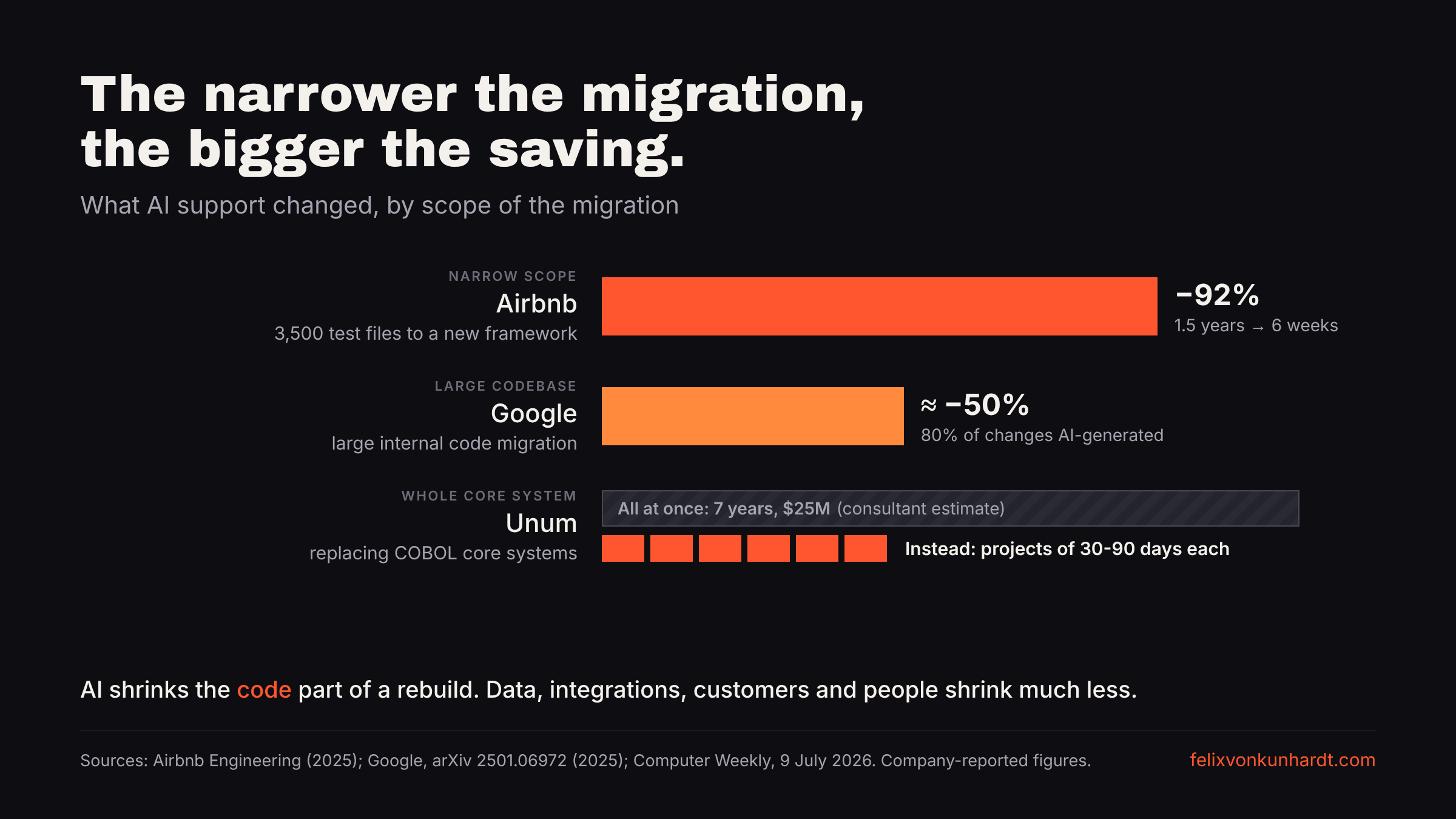
The pattern: the narrower the migration, the bigger the saving. And if your migration isn’t narrow, you can make it narrow. AI makes the code part of a rebuild dramatically cheaper. The data, the integrations, the customer migration, the contracts and the organization get much less cheap. And the bigger the company, the bigger that second part is.
I remember a client back in 2020 with a huge monolithic software stack. The leadership team considered it so bad and clumsy that we seriously discussed rewriting it from scratch. The estimate was one to two years (!), with no innovation for customers in the meantime. For a company in a competitive market, that was close to a suicide mission. Today the same discussion would start from a very different estimate.
That’s why the opportunity is largest for smaller companies. A scale-up with a few years of code and a few hundred customers can rebuild its core in months now, where it used to take one or two years. I saw a small version of this myself: on a platform I’m building, the second iteration took one week instead of eight, and the hardest part was deciding to throw away something that worked.
For large companies it’s possible too, but there it remains above all a strategy decision for leadership.
6. Where the window really opens
Putting it together, I see the window opening fastest in three places:
- Verticals with weak software but strong customer relationships. Where the incumbent product is old and the customer relationship is what keeps it alive, a better product sold through the same relationships can move fast.
- Products priced per seat. When customers need fewer people for the same work, per-seat revenue shrinks on its own. Pricing by outcome is the obvious answer, and incumbents are moving: Salesforce now charges $0.10 per agent action, Intercom from $0.99 per resolved conversation.13
- Products whose advantage was the interface. If more of the work is done by agents, a nicer screen protects less.
7. What I learned at a company that rebuilt itself
At a company I worked for, I saw what it takes to rebuild a business on a new platform without stopping the one that pays the bills. It started as a pure services business and moved step by step to automation and a platform. Every step had to work for customers who were already live, in many countries at once.
The lesson I took from that: replatforming is a sequence of product decisions about what to move first, what to leave alone for now, and what to stop doing altogether. The technology made each step possible. The judgment about the order made it work.
8. What incumbents should do now
Adding AI features to the old product is not enough. The more useful questions are uncomfortable ones:
- If we started from scratch today, what would we build?
- Which parts of our product would we not rebuild at all?
- Are we willing to put some of today’s revenue at risk to get there?
Answering them takes product teams with a real mandate to make decisions. It takes a shared definition of what “better” means, so that a rebuild doesn’t just reproduce the old product in new code. And it takes leaders who accept that cannibalizing your own revenue is cheaper than letting someone else do it.
9. What challengers should keep in mind
For challengers, the advice is the mirror image. Windows close: customers don’t switch core systems every year, and once they have moved, they stay put again for a while. That’s why investors expect a lot of capital to be needed quickly.
Make the migration part of the product, so the customer doesn’t have to run it as a project. And remember that integration is the entry ticket. At Decibel we learned that before anyone talked about replacing anything, we had to fit into what customers already used.
The short version
Building got cheap. Switching is getting cheaper. Judgment still isn’t.
The companies that do well in this window, on either side, will be the ones that decide best what to rebuild, what to leave behind, and when.
If you lead a software company and these questions keep you up at night, I would love to compare notes. Feel free to get in touch.
Sources
- Reuters, “US software stocks stabilize after bruising selloff,” 5 February 2026 (see also 3 February 2026). finance.yahoo.com ↩
- Carta, “After the ‘SaaS-pocalypse,’ a new era begins for PE-backed software companies,” Q3 2026. carta.com ↩
- Dealroom, SaaSpocalypse dashboard (Stripe payments index, non-AI SaaS, 52 weeks to 24 August 2026). dealroom.co ↩
- Bain & Company, “The new era in tech investing starts now,” 30 April 2026. bain.com ↩
- Battery Ventures, State of Enterprise Tech Spending, June 2026. battery.com ↩
- Campfire, Rillet and DualEntry, comparison pages vs. NetSuite (vendor statements). campfire.ai · rillet.com · dualentry.com ↩
- Gem, ATS migration guide; Ashby, “Migrating to Ashby” (vendor statements). gem.com · ashbyhq.com ↩
- Juicebox, “AI recruiting platform consolidation.” juicebox.ai ↩
- Andy Jassy on Amazon Q code transformation, August 2024 (company estimate), as reported by The Decoder. the-decoder.com ↩
- Airbnb Engineering, “Accelerating Large-Scale Test Migration with LLMs,” March 2025. medium.com/airbnb-engineering ↩
- Google, “How is Google using AI for internal code migrations?” arXiv 2501.06972, January 2025. arxiv.org ↩
- Computer Weekly, “Insurer Unum aims to deliver benefits of $20m using AI to re-write old Cobol code,” 9 July 2026. computerweekly.com ↩
- Salesforce, “Flex Credits”; Intercom, Fin pricing. salesforce.com · intercom.com ↩