“We just set a new denominator for the job. And it moves higher and higher every month.”
That sentence comes from a tech worker in this year’s survey by Lenny Rachitsky and Noam Segal, and it describes the conversations I have been having with product people all autumn.1 Nobody I talk to is bored. Nobody is out of work. Most of them are doing the work of what used to be a small team, with a smaller team, while the rest of the company has discovered that it can build things too.
Product managers are on the hot seat. I want to explain why that seat got so hot, why the obvious reaction (work faster, produce more) makes it hotter, and what I would do instead.
1. Three things happened at the same time
Each of these would have been manageable on its own. Together they are a different job.
Expectations went up. Since April 2025, teams at Shopify have to “demonstrate why they cannot get what they want done using AI” before they get headcount.2 Amazon’s CEO told his staff to “get more done with scrappier teams” and expects the corporate workforce to shrink.3 Whatever you think of these memos, they set the tone for every board and every CEO who read them. The 2026 survey puts a number on how that lands: 51% of tech workers say their biggest AI-related fear is “being expected to do more for the same pay”. Only 22% fear losing their job to AI.1
Resources went down. Microsoft’s security division ran at about 5.5 engineers per PM and wanted 10.4 When the company cut 373 product management roles in Redmond in May 2025, a Windows executive wrote to the survivors: “In a leaner PM organization, each of you will have significantly larger scope.”5 That memo could have been written at most companies I know. Design teams have been thinned out even more than product teams: open design roles have been flat since 2023, while PM openings recovered.6 The PM picks up the design-adjacent work.
Inflow went up. This is the part the surveys don’t measure yet, and it is the one that everyone describes. Marty Cagan estimates that “10-20 prototypes (or prototype iterations) per week is easy for just about anyone” now.7 Replit’s CEO describes executives who show up to meetings with a working prototype and say “look what I built”.8 Sales builds demos. The CEO builds one on a Sunday. All of it lands in the same inbox. Atlassian’s research calls the result a “fragmentation tax”: “reviews, approvals, and alignment decisions can’t keep up with the flood of new work.”9
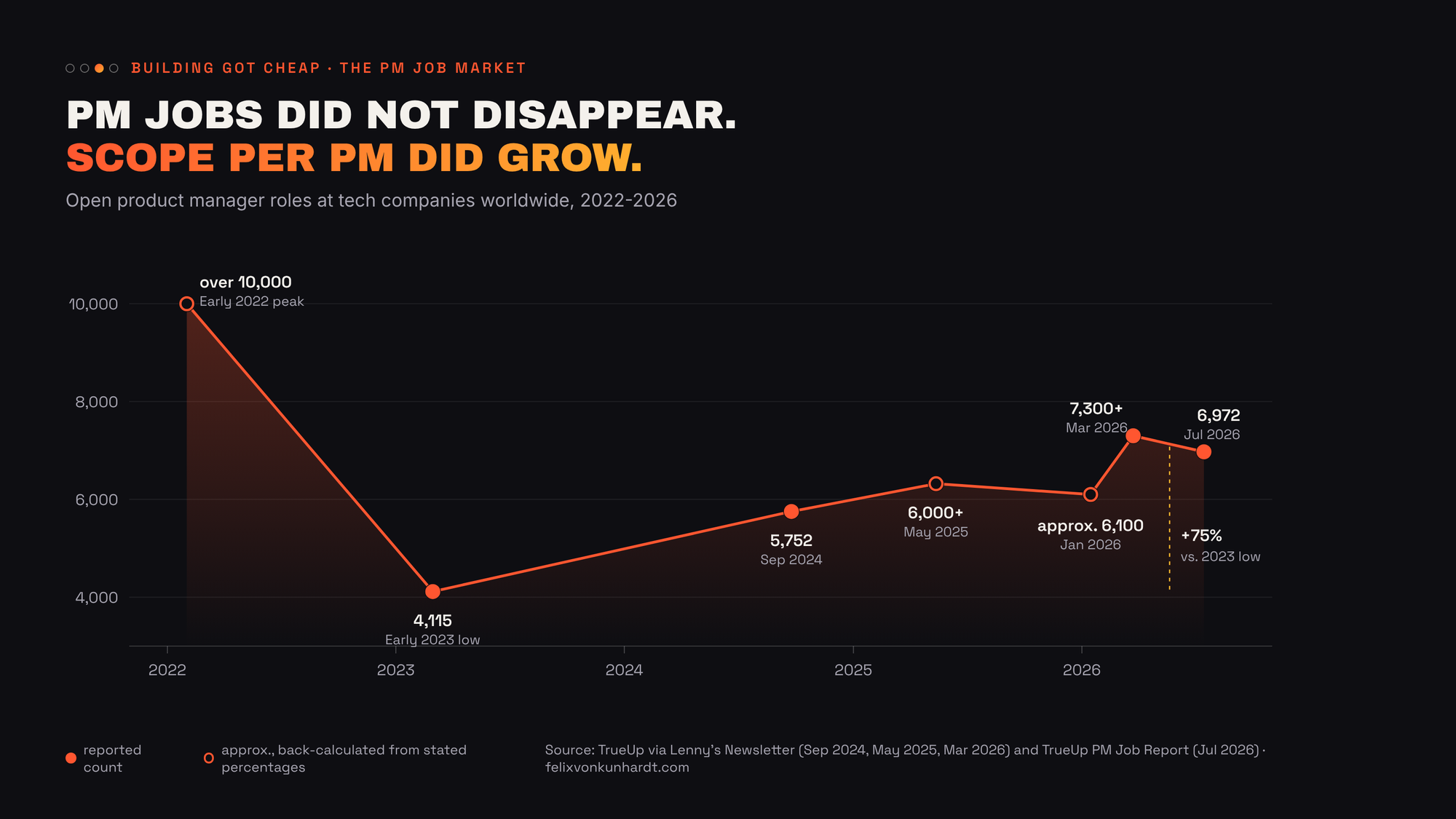
One correction to the “crisis” story, because the people who read Lenny will know the numbers: PM jobs are not disappearing. In March 2026 there were more than 7,300 open PM roles at tech companies, the most since 2022 and 75% above the low of early 2023.6 The squeeze is about intensity, and that makes it harder to see. Headcount is a number on a slide. “Each of you will have significantly larger scope” never shows up on one.
2. The bottleneck moved to you
Here is the way I think about it.
For twenty years, the scarce resource in product development was engineering capacity. Everything about the PM job was shaped by that: the roadmap, the prioritization frameworks and the quarterly planning fights over both. Your job was to make sure the scarce thing was spent on the right things.
Building got cheap. The scarce thing moved. Andrew Ng tells the story of one of his teams proposing a ratio of one PM to half an engineer, something that “would have sounded absurd a year ago”.10 Whether that ratio is right is beside the point. The point is where the constraint now sits: in deciding what is worth building, what a prototype actually proves, and what to say to the executive who built one.
That decision used to be spread across a team with a designer, a researcher and a few engineers who pushed back. Now it sits with you, with fewer people around you, and with far more input coming in. The constraint moved, and it moved onto one chair.
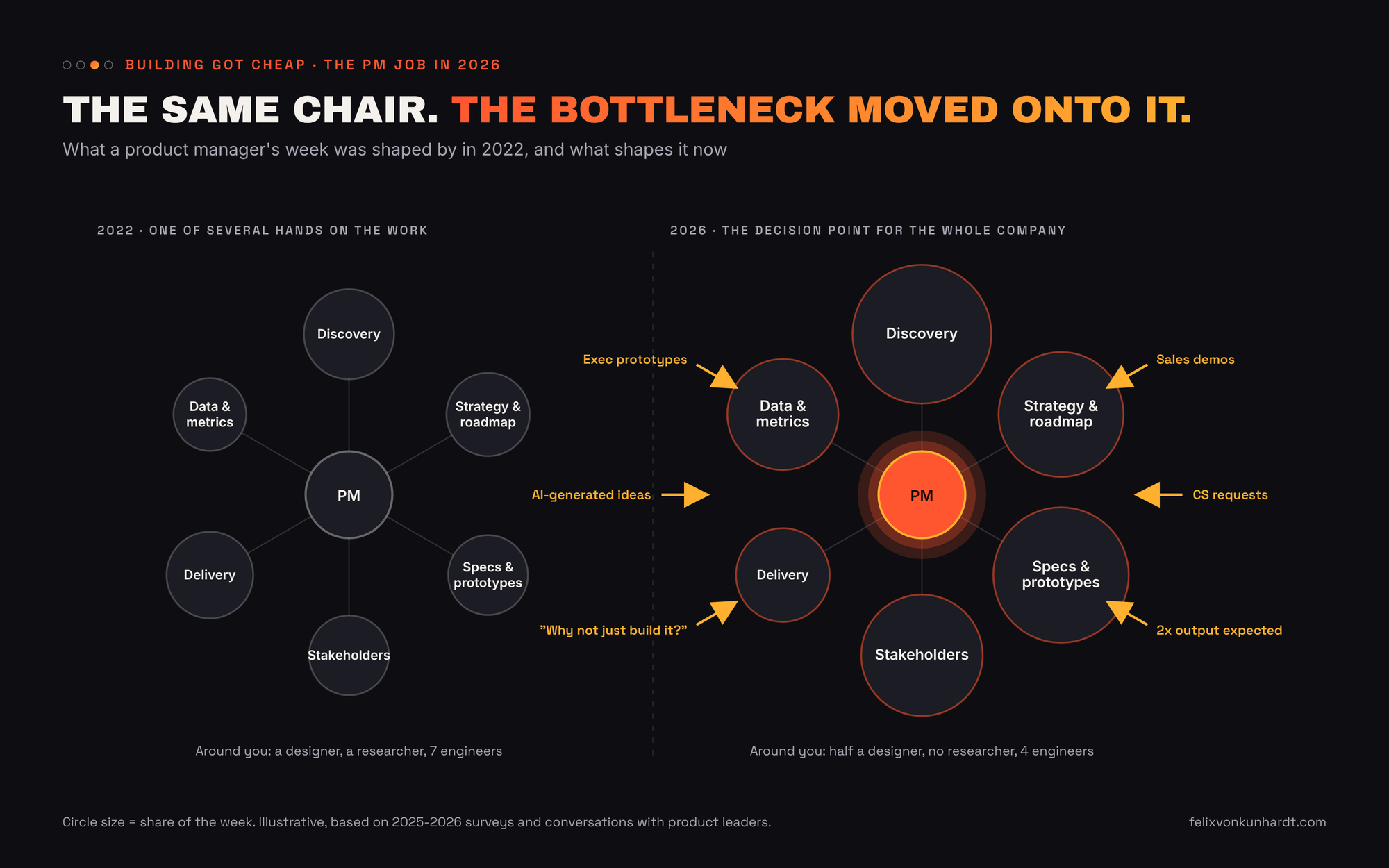
This is why I resist calling it a crisis of the role. A crisis would mean the role is in doubt. What I see is the opposite: the role has become the point where everything in the company backs up. That is uncomfortable, and it is also leverage, if you treat it that way.
3. Why producing more makes it worse
The natural reaction to a flood is to bail faster. Use the tools, write the PRD in ten minutes, review the prototype tonight, keep up.
The evidence says this is a trap. Two researchers from Berkeley spent eight months inside a tech company watching what AI tools did to people’s work. Their conclusion, published in HBR this February: AI doesn’t reduce work, it intensifies it. People “worked at a faster pace, took on a broader scope of tasks, and extended work into more hours of the day, often without being asked to do so.”11 The Lenny survey shows the same thing at scale: 82% say AI makes them better at their job, and in the same year burnout rose from 45% to 56%.1 As the authors put it: “Every gain becomes the new baseline.”
Atlassian’s product survey has a number that sums it up. AI saves product teams up to two hours a day. 49% of them still have no time for strategy.12 The saved time goes straight into the queue.
And the queue itself is the problem. Cagan calls today’s project model “a turbo-charged feature factory, capable of producing more bad products, faster, than ever before”, and quotes Hilary Gridley: “It’s never been faster to build, which means it’s never been easier to run 10 times faster in the wrong direction.”7, 13 Companies feel it: 89% of executives say AI has accelerated speed, and only 6% can point to specific ROI.9
So if the bottleneck is judgment, the way out of the hot seat is to spend your judgment on fewer things. You need filters more than you need throughput.
4. Filters over throughput: six things I would do
Make the strategy the filter. A written product strategy with two or three outcome goals per team is the only thing that makes “no” cheap. Without it, every idea is argued on its own merits, and the loudest person wins. With it, most ideas answer themselves. Productboard found that nearly 39% of failed product investments fail because of a missing company strategy, up from 25% a year earlier.14 If your company has no written strategy, write one yourself, one page, and get your boss to sign it. It is the highest-leverage document you will produce this year.
Put back-pressure on intake. John Cutler’s advice for teams fed by “a high volume of interrupts” is structured intake, a prioritization forum and explicit economic trade-offs.15 In practice: every request gets a short written “why”, from the requester, before anyone looks at it. One product leader I read about asks for a two-pager and says it filters out about 70% of non-critical requests.16 I believe that number. Most requests die the moment someone has to write down what problem they solve. The ones that survive are the ones worth your time.
Treat every prototype as a hypothesis. The executive demo is the hardest case, because it arrives with authority attached. Cagan’s framing helps here: build to learn vs. build to earn.7 A prototype is a build-to-learn artifact. It is a question, and a good one. The right response is “great, what does this need to prove, and how do we test it?” rather than putting it on the roadmap or fighting it. Name the stage out loud. Most executives are fine with “this goes into discovery” if you say it before they hear “no”.
Use AI on the inbound side. Most PM advice about AI is about output: faster PRDs, faster research summaries. That is the intensification trap in tool form. The better use is on the inbound side. Let a model structure the Slack thread into a request, match it against the strategy, cluster it with the twelve similar requests from last quarter, and show you a triaged queue instead of a thread.17 One team I like runs a weekly rotation where one PM reviews all feedback channels for everyone.18 That is the kind of AI use that gives you time back, because it cuts the input, and the input is what is drowning you.
Make the trade-off visible. More than 60% of prioritization frameworks get overridden by leadership escalations.19 You will never win the argument about the framework. You can win the argument about the trade-off. Every escalation becomes an explicit swap: “we can do this, and it means X moves out of the quarter, and here is the outcome we had planned for X.” Cagan’s version is predictability vs. outcomes: make leaders choose, explicitly, which one they want.13 Put the swap in writing. The second time an executive sees their own name next to the thing that slipped, the escalations get fewer.
Protect your pace on purpose. This sounds soft and is the most practical point on the list. The Berkeley researchers recommend sequencing work instead of continuous responsiveness, and deliberate pauses.11 For a PM that means: a fixed slot for discovery that is treated like a customer meeting, a fixed slot for reviewing inbound (and none outside it), and the discipline to let a prototype sit until that slot. Nobody will give you that time. You take it.
5. For product leads: the hot seat is your job
If you lead product managers, most of what I just wrote applies twice. The strongest single finding in the Lenny survey is that manager quality remains the strongest driver of burnout, and one of the strongest drivers of everything else.1 Only a quarter of tech workers rate their manager as highly effective.
So the filter is yours to build. Three things I would do before anything else:
- Own the intake. Your PMs should never be the first person an executive’s prototype meets. You are. That is what the role is for.
- Take coordination off their plate. When Airbnb reshaped its product organization in 2023, the part that got the most attention was the merger with product marketing. The part that mattered more was moving program management to actual program managers and making the group “smaller and more senior”.20 Atlassian’s data points the same way: teams with a product operations function score 30 points higher on strategic empowerment.12 Your PMs are the bottleneck. Everything that isn’t judgment should be somewhere else.
- Say the trade-off before they have to. When the CEO wants one more thing this quarter, the answer “yes, and here is what moves” should come from you, in the room, with the outcome attached. If your PMs are having that conversation alone, you have left them on the hot seat.
The short version
Building got cheap. Expectations went up, teams got smaller, and the company discovered it can prototype. The constraint moved from engineering capacity to product judgment, and it moved onto you.
Filtering gets you out of the hot seat, and producing more keeps you in it. The filter: a written strategy, intake with back-pressure, prototypes as hypotheses, AI on the inbound side, explicit trade-offs, and a pace you protect yourself. If you lead PMs, that filter is your job before it is theirs.
If this sounds like your product organization, I would love to compare notes. Feel free to get in touch.
Sources
- Noam Segal and Lenny Rachitsky, “How tech workers are feeling in 2026: a workforce splitting in two”, Lenny’s Newsletter, July 7, 2026 (approx. 6,000 respondents, self-selected). lennysnewsletter.com ↩
- Tobi Lütke, internal Shopify memo, published April 7, 2025, as reported by CNBC. cnbc.com ↩
- Andy Jassy, memo to Amazon employees, June 17, 2025, as reported by CNBC. cnbc.com ↩
- Business Insider, April 2025, on Microsoft’s “PM ratio” (via TechSpot). techspot.com ↩
- Seattle Times, May 2025, on Microsoft’s Redmond layoffs (WARN filings: 817 software engineering and 373 product management roles) and the internal Windows memo. gmtoday.com ↩
- Lenny Rachitsky, “State of the product job market in early 2026”, March 24, 2026, based on TrueUp data; earlier editions September 2024 and May 2025; TrueUp Product Manager Job Report, July 2026. lennysnewsletter.com · trueup.io ↩
- Marty Cagan, “Build to Learn vs Build to Earn”, SVPG, April 16, 2026, and “Build To Learn FAQ”, April 27, 2026. svpg.com ↩
- Amjad Masad (Replit) on the Possible podcast, as reported by SaaStr, 2025. saastr.com ↩
- Atlassian, “State of Teams 2026” (12,035 knowledge workers, 173 Fortune 1000 executives), as cited in Atlassian’s blog, May 28, 2026. atlassian.com ↩
- Andrew Ng, talk at Y Combinator’s AI Startup School, 2025. lovex.dev ↩
- Aruna Ranganathan and Xingqi Maggie Ye, “AI Doesn’t Reduce Work - It Intensifies It”, Harvard Business Review, February 9, 2026 (eight-month ethnography at one US tech company). hbr.org ↩
- Atlassian, “State of Product 2026”, September 2025 (1,000+ product professionals, US and Europe); product-ops figure via Diginomica. atlassian.com · diginomica.com ↩
- Marty Cagan, “The AI Productivity Paradox”, SVPG, July 23, 2026, and “Predictability vs Outcomes”, October 2026. svpg.com · svpg.com ↩
- Productboard, CPO Survey 2025, as reported by Ant Murphy. antmurphy.me ↩
- John Cutler, “TBM 415: Demand Mix, Shaping, and AI”, April 9, 2026. cutlefish.substack.com ↩
- Karan Peri on the Horizons Pod, 2026 (anecdotal figure). horizonspod.substack.com ↩
- Aakash Gupta, on a Claude-Code-based intake system at an AI startup, X, 2026 (second-hand). x.com ↩
- Tanguy Crusson (Atlassian, Jira Product Discovery) on Aakash Gupta’s podcast. news.aakashg.com ↩
- ProductPlan / Product-Led Alliance, “State of Product Management 2026” (250 product leaders). productplan.com ↩
- Brian Chesky on Lenny’s Podcast, November 2023, on Airbnb’s product reorganization. airfocus.com ↩