Last weekend Aakash Gupta put a stopwatch on a question many software leaders are asking themselves1. He wrote a one-page spec of Linear, using only the public docs, and handed it to a coding agent. Three and a half minutes later he had a working issue tracker with statuses, priorities and a command menu. The clone only covered the core board and issue flow. Still, that is the heart of a company valued at around $2.5 billion, rebuilt before the coffee got cold.
On November 12 I am on a panel in Munich called “Moats in the Era of Vertical AI”, at the Verticals Summit. This piece is my attempt to think the question through before I sit down on stage - for the companies in that room: vertical software for small and mid-sized businesses. It builds on my last piece, Building Got Cheap. Now Switching Is Getting Cheaper.
1. What stopped protecting you
The first thing that broke is the obvious one: features. If a competitor can describe your product on one page, an agent can build a decent version of it. It will miss many of the edge cases you learned the hard way, but it is good enough for a demo, and good enough to make your sales team nervous.
The second thing is quieter. For years, users’ habits were a small moat of their own. People knew where the buttons were, and switching meant relearning. Agents don’t have muscle memory. When more of the work is done by an agent calling your product, your carefully designed interface protects less than it used to.
A family office investor I spoke with in the summer described two directions of attack, and I think he is right. The first: a competitor builds the same thing in weeks. The second is harder to defend against: the foundation model simply does the job. Whole categories that used to justify a company become a question you type into a chat window.
The markets noticed early. Software stocks fell sharply in the first months of 2026, and investors have been more careful with software revenue ever since. I went through the numbers in my last piece.
2. Switching is getting cheaper, too
That caution has a reason. Software revenue used to rest on switching costs: moving off a core system was painful enough that most customers never tried. This is changing as well. Challengers now sell the migration as part of the product, and customers sign shorter contracts.
The code part of a migration got much cheaper. The people part didn’t: retraining a team, rewriting processes, convincing the person who once chose the old system - all of that still takes months, and in a small business it competes with running the business. So the technical lock-in is melting, while the organizational one stays.
I would call that inertia, and inertia runs out the moment a new product feels clearly better from day one.
3. Five questions that still hold
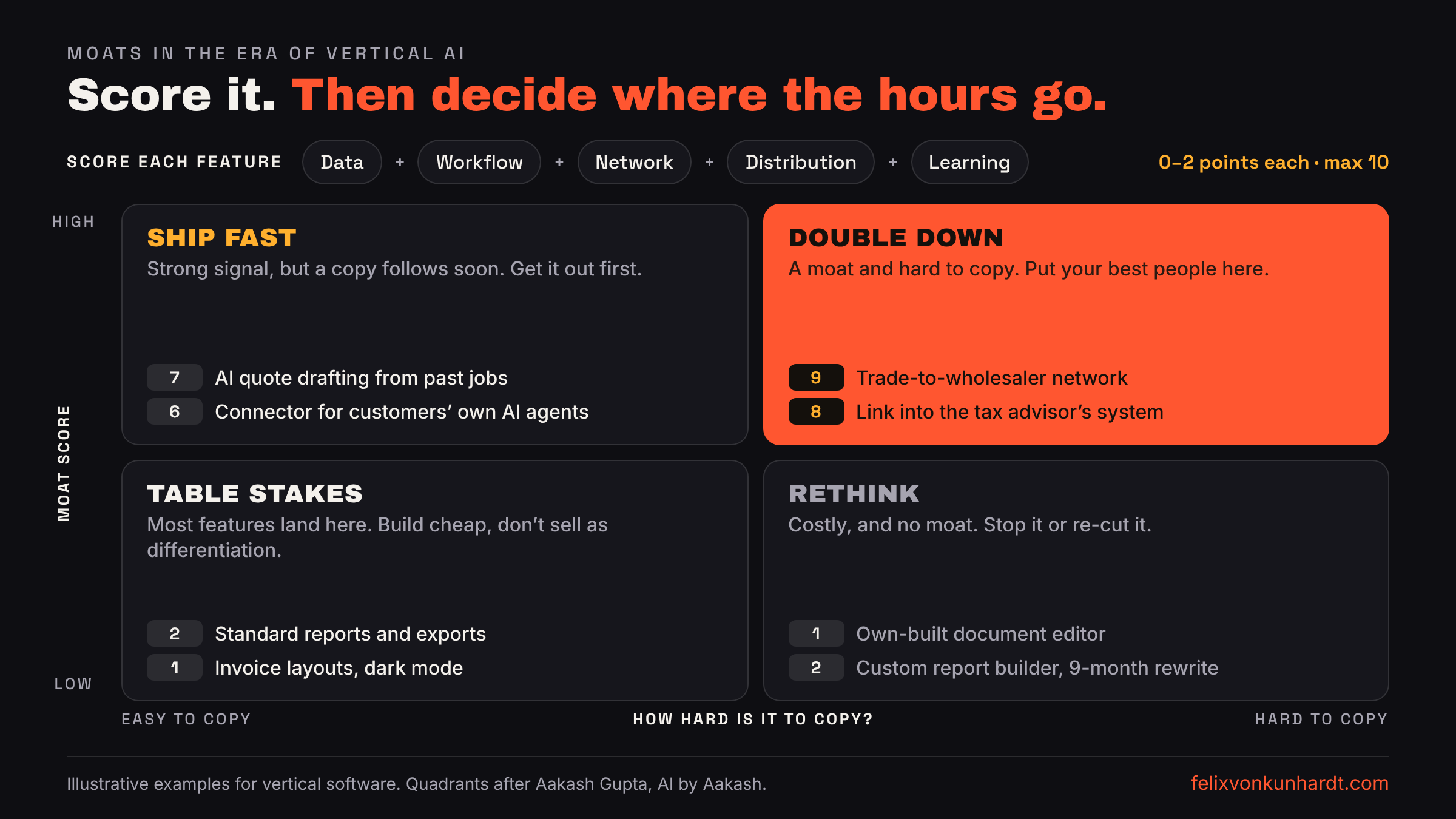
So what does hold? Aakash offers a simple scorecard that I find useful1. For each feature, ask five questions and give zero to two points each:
- Data: Does using it create data a competitor can’t buy?
- Workflow: Does the customer’s work start living in it?
- Network: Does it get better as more people use it?
- Distribution: Does it reach users where they already are, agents included?
- Learning: Will we keep tuning it after launch?
Most of these are classic ideas. What I find more useful is translating them into the world of vertical software for small businesses, because there they look quite different from the Silicon Valley version.
Data. In a vertical, every job, claim, order or recipe that runs through your product can make it better for the next customer. The investor I mentioned called it a data flywheel: anyone can build the model, but you get specifically better with every customer request in your field. The catch is that the data has to be legally usable, technically accessible and actually used. Many vertical companies sit on years of data that never flows back into the product.
Workflow. In a company with twenty people, your software is often the only real system they have. If the day runs in it - scheduling, documentation, invoicing - you have something a clone can’t copy: the context. Nobody moves everything just because a general AI tool could do part of it, if all their history lives with you.
Network. Inside a single small customer, network effects are rare. Between market participants they are not: the trade business and the wholesaler, the practice and the lab, the company and its tax advisor. Products that connect these sides get better with every new participant, and that is very hard to rebuild from a spec.
Distribution. For small businesses, this is the most underrated one. In Germany, a lot of small-business software lives or dies by its connection to DATEV, simply because that is where the tax advisor works. Industry associations, wholesalers and chambers play a similar role. An agent can copy your code. It can’t copy the tax advisor who recommends you. And there is a new channel to think about: is your product reachable for the agents your customers are starting to use?
Learning. The last question is different from the other four: it describes the team.
Aakash also sorts features into four boxes, by score and by how easy they are to copy. The box that matters most is the least exciting one: table stakes. Most features land there. That is fine - as long as you stop selling them as differentiation, and stop staffing them as if they were.
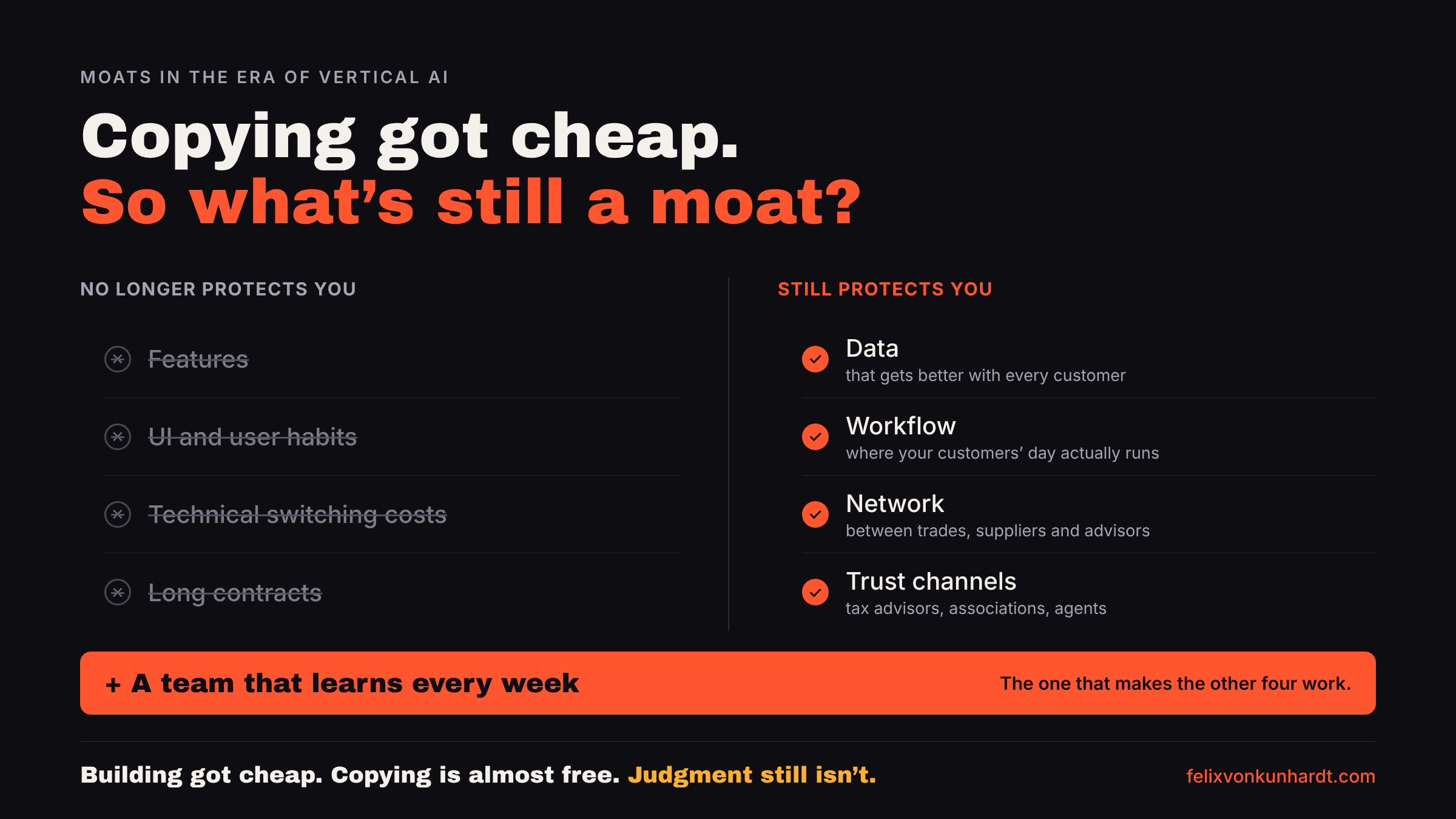
A few days after Aakash’s piece, Sam Altman gave his own answer in an interview with Matthew Berman2. Asked what still protects a company once every lab has a great model, he named four old moats: deep customer relationships, integration into people’s lives and businesses, network effects and data. That is close to the list above, coming from the person whose models make copying cheap. His one caveat is recursive self-improvement: if labs pushed hard on models that improve themselves, the model itself could become the moat. He calls that “a very dangerous thing to push on”.
His list has four entries. The fifth one, the team, is where I want to spend the rest of this piece.
4. A moat is something a team does
This is where I want to add something to the scorecard.
The five questions are simple. Applying them honestly is hard. In most companies I have worked with, the roadmap comes from customer requests, sales commitments and the loudest stakeholder. Roadmaps like that are full of zeros, usually because nobody has the mandate to say no. You can’t score your way out of a feature factory.
The learning question shows this most clearly. “Will we keep tuning it every week?” sounds like a product property. In practice it is a question about the operating model, and it needs a team that owns an outcome rather than a list of features, a shared definition of what “better” means, and kill criteria that are agreed before anything gets built. Without that, a feature ships and freezes, no matter how good the idea was.
Aakash ends with a question I like a lot: if a new model drops next month, does your company get better or worse? Companies whose roadmap is built on data, workflow and learning get better, because the new model makes their accumulated advantage more useful. Companies whose roadmap is mostly interface and features get worse, because the new model mostly helps their competitors.
Answering it is a job for leadership. For established companies it often means putting some of today’s revenue at risk - rebuilding the part of the product you would not build the same way today, even if it still sells. For challengers it means using the window while it is open, because windows close.
Altman makes a related point about AI itself: people should keep the key decisions, and a good model should behave like a senior colleague who pushes back when it has high conviction2. Inside a company, that also describes a good product team.
A moat used to be something you had. Now it’s something your team does every week.
5. What eBay taught me about copying
I learned this lesson early. At eBay, competitors could and did copy what they could see: listings, search, the checkout flow. What they could not copy were the buyers and sellers who were already there, and the trust built up in years of ratings. Every new seller made the marketplace more attractive for the next buyer, and the other way around.
The technology of the time is long gone. The network is still there. I think that is a good test for any product today: if you imagine your entire codebase leaked tomorrow, what would still be yours?
6. A 60-minute moat review
If you lead a vertical software company, here is a simple way to start, based on Aakash’s steps with a few additions of my own:
- Put the ten biggest roadmap items on the table. Just the ten that take most of your team’s time, leaving the backlog aside.
- Score each one on the five questions, zero to two points. Everyone scores alone first, then you compare. The disagreements are worth more than the numbers.
- Run the copy test on the two most expensive items. Write a one-page spec and give it to a coding agent. How far does it get in an afternoon?
- Sort and act. Table stakes go to one person with AI tools: fast and cheap. High scores that are hard to copy get your best people. Expensive items that score low get stopped or re-cut.
- Change your spec template. Every spec gets one line: “Which moat does this strengthen?” Plus an owner and a kill criterion. If the moat line stays empty, it’s a parity feature, and it gets the budget of one.
The first time you do this, it will feel uncomfortable. Some favorite projects will score low. That is the point.
The short version
Building got cheap. Switching is getting cheaper. Copying is almost free. Judgment still isn’t.
If you’re at the Verticals Summit on November 12, I would love to continue this conversation in person. And if you want to run a moat review with your leadership team, feel free to get in touch.
Sources
- Aakash Gupta, “Reverse Engineer Anything: What’s Still a Moat?” AI by Aakash, 18 October 2026. aibyaakash.com ↩
- Sam Altman in an interview with Matthew Berman, 21 October 2026. Summary: Ruben Dominguez, “Sam Altman Gave Up Coding a Year Ago. Here Is the Renaissance He Wants AI to Build,” The AI Corner, 26 October 2026. ↩